
The Borealis: One of the biggest passenger rail success stories in the Midwest!
Overview
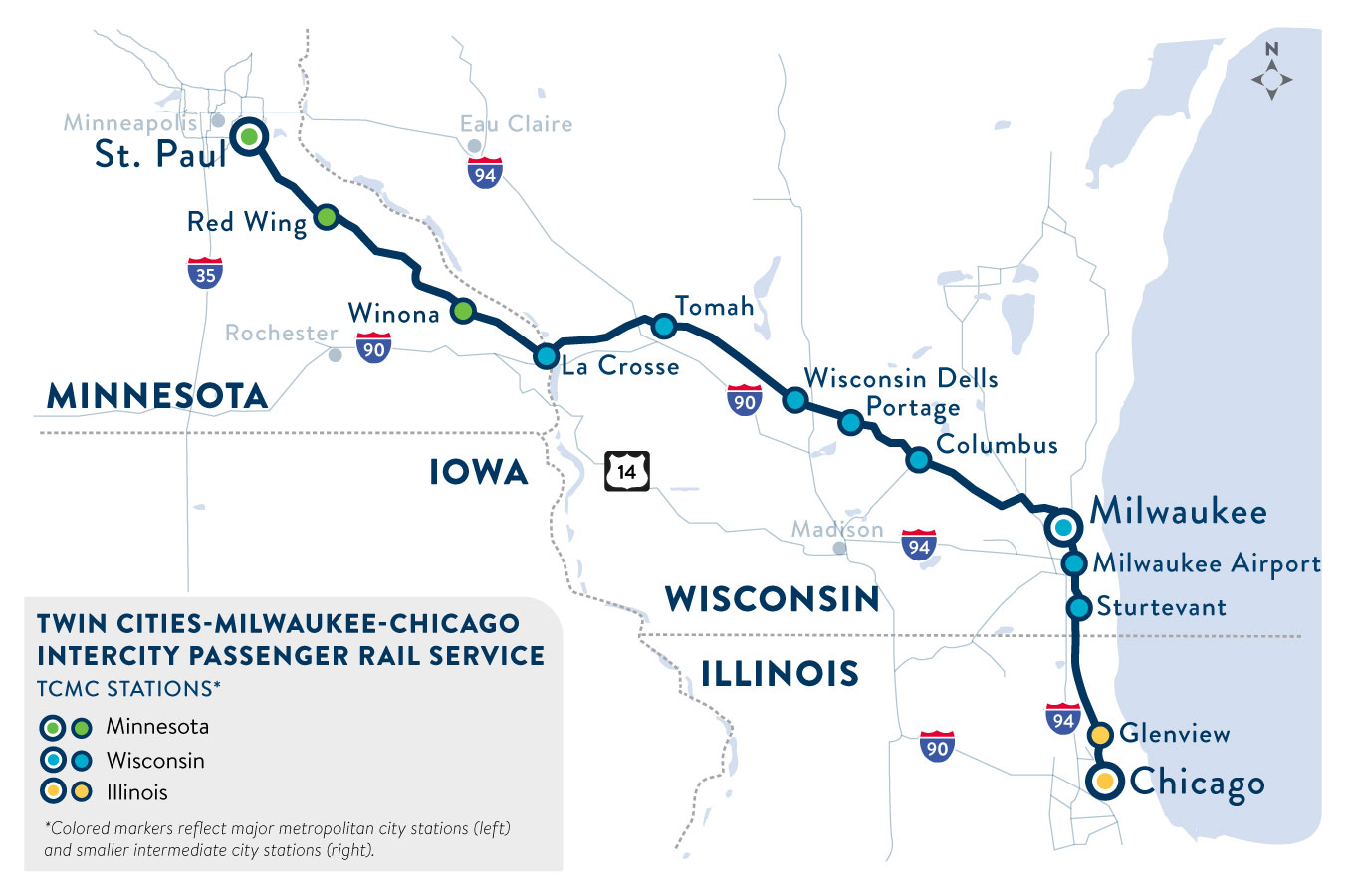
Commencing operation in May 2024, the Borealis remains immensely popular and continues to see impressive ridership. Despite capacity limitations due to equipment shortages, over 416,000 passengers have ridden the Borealis in its first two years of service. All Aboard Minnesota worked for a decade to make the case for funding and implementation. We continue to celebrate its success and work for new fleet and additional frequencies.
The Borealis is a state-supported train operating one roundtrip per day between Saint Paul, Minnesota and Chicago, Illinois. While Amtrak provides the service, crews, and trains for the Borealis, the route itself is a joint venture between MnDOT, WisDOT, and IDOT. It also receives funding from the Federal Railroad Administration.
The route is 411 miles from Saint Paul Union Depot to Chicago’s Union Station and takes just under 8 hours. It passes over the same tracks – mostly owned by the Canadian Pacific, Kansas City (CPKC) railroad – that the long-distance Empire Builder does while stopping at a couple additional stations along the way. This service provides a much-needed midday travel frequency between the two major metro regions.
Ridership and On-Time Performance (OTP)
The removal of Horizon coaches from service (across the US) in early March 2025, and replacement with three Superliner coaches (vs. four Horizon cars plus a business café car) continues to reduce each train’s capacity. The original capacity was already too limited. The numbers suggest that the current demand for this service is around 400 seats per train, almost double the current capacity. This service’s frequent sellouts indicate it turns away thousands of customers each month, especially during peak travel times.
In FY2025, just over 40 percent of Borealis customers arrived more than 15 minutes late to their destinations (An Amtrak metric for on-time performance), a minor improvement over 2024. In 2026, Amtrak shifted the timetable of the Borealis ahead by about half an hour to accommodate construction, primarily around Winona, La Crescent, and La Crosse. These improvements will reduce travel time and improve station access.
Borealis Stats FY 2025
| FY2025 | |
| Ridership | 212,900 |
| Load Factor | 72% |
| Cost Recovery | 50% |
| OTP (On-Time Performance) | 56.9% |
Learn more about detailed ridership information (by station)
Learn more about quarterly on time performance
Empire Builder ridership was flat in FY2025, not down, showing that Borealis did not “steal” customers from the Empire Builder. East of Saint Paul, the Empire Builder typically remained full, or nearly full, despite its aging equipment and chronic lateness.
Empire Builder Stats FY 2025
| FY2025 | Compared to FY 2024 | |
| Ridership | 364,500 | Down 6% from 2024, up 4% from 2023 Up 4% from 2023 |
| Load Factor | 48% | Same |
| Cost Recovery | 53% | Improved 3% |
| On-Time Performance | 53.1% | Worse 2.4% |
History
The rail corridor between the Twin Cities and Chicago has a rich history. At its peak, the Milwaukee Road, CB&Q, Northern Pacific, and the Chicago & Northwestern ran consistent, timely services between the two locations. In 1971, Amtrak retained some of these routes when it took over passenger rail service.
Over time, Amtrak began to cut routes over the corridor, leaving only the Chicago to Seattle/Portland Empire Builder remaining into the 2000s. With the Empire Builder’s inconsistent and sometimes inconvenient schedule, riders needed additional rail service along the corridor.
Timeline
-
May 2012 – MnDOT requests a study on a new train frequency between Chicago – Milwaukee – La Crosse – Twin Cities – (St. Cloud) (TCMC) with the Federal Railroad Administration (FRA).
- 2015 – Amtrak releases their report for the proposed corridor.
- 2017 – MnDOT and WisDOT complete and hold public hearings on their environmental impact reviews.
- May 2020 – The Federal Railroad Administration (FRA) Restoration & Enhancement Program grants $12.6 million to help cover the first three years of service.
- September 2020 – The project receives a $31.8 million FRA Consolidated Railroad Infrastructure and Safety Improvement (CRISI) grant to improve infrastructure. MnDOT, WisDOT, and IDOT also contribute, providing a total of $53 million towards route infrastructure.
- 2022 – Submitted by WisDOT, the TCMC Service Expansion via La Crosse receives a one-time federal grant of $500,000 through the FRA’s newly-created Corridor I.D. Program to continue studying the route’s feasibility.
- November 2022 – MnDOT and WisDOT hold public meets detailing the project’s final design and construction.
- 2023 – Corridor I.D. grant received. Sources suggests service should begin in FY2024.
- May 1st, 2024 – Amtrak announces the beginning of the Borealis service later that month and places tickets on sale.
- May 21st, 2024 – First day of service!
Borealis Funding
The Borealis is a state-supported train with MnDOT serving at the lead agency in Minnesota working with other state DOT partners along the corridor. Minnesota’s share of capital and operating costs is provided by the Minnesota legislature. The federal government is a key funding partner.
Capital and Research Funding
- September 2020
- Federal Railroad Administration (FRA) - $31.8 million grant
Consolidated Railroad Infrastructure and Safety Improvement (CRISI) grant) - Amtrak – $5 million – Committed funding
- MNDOT – $11.8 million – Matching funding
- WisDOT – $6.2 million – Matching funding
- Federal Railroad Administration (FRA) - $31.8 million grant
- 2022 – $500,000 – Federal grant from the FRA for the Corridor I.D. program awarded and received in FY2023.
Operational Funding
- May 2020 - $12.6 million - Federal Railroad Administration (FRA) Restoration & Enhancement Program grant to help cover the first three years of service.
- 90% offset of net operating costs in year one
- 80% offset of net operating costs in year two
- 60% offset of net operating costs in year three
- January 2025 - $38.6 million - Federal Railroad Administration (FRA) Restoration & Enhancement Program grant that augments the initial $12.6 million to help offset operating costs for the first 6 years of service.
- On-Going Operational Expenses
- MN, WI, and IL share on-going operational costs.
Celebrating the Borealis
Every May 21st, All Aboard Minnesota celebrates the Borealis’ birthday at Saint Paul Union Depot by sending off departing passengers in the morning and welcoming arriving passengers in the evening. In 2026, we celebrated the Borealis’ 2nd Birthday. AAMN also participates in Train Day the first week in June at Saint Paul Union Depot. All Aboard Minnesota informs participants about the Borealis service and its success and also the Empire Builder.
Fleet
Current passenger capacity on the Borealis is just over 200 passengers per train – down 25 percent from when the train operated with four Horizon cars and a business café car. The train’s current consist includes:
- Two (2) Locomotives, one at each end of the train. GE Genesis P42 and/or GE Dash 8-32B.
- Three (3) bi-level Superliner coaches. One includes a café on the lower level.
Updates from Wisconsin Association of Railroad Passengers
Learn more about ridership from our friends at the Wisconsin Assocation of Railroad Passengers.
Future Expansions
We are working on future expansions. Learn where we're heading.
Detailed Borealis News
If you are interested in more detailed news and history about Borealis service, please email [email protected].